
This Week in Digital Assets: 25–28 August 2026
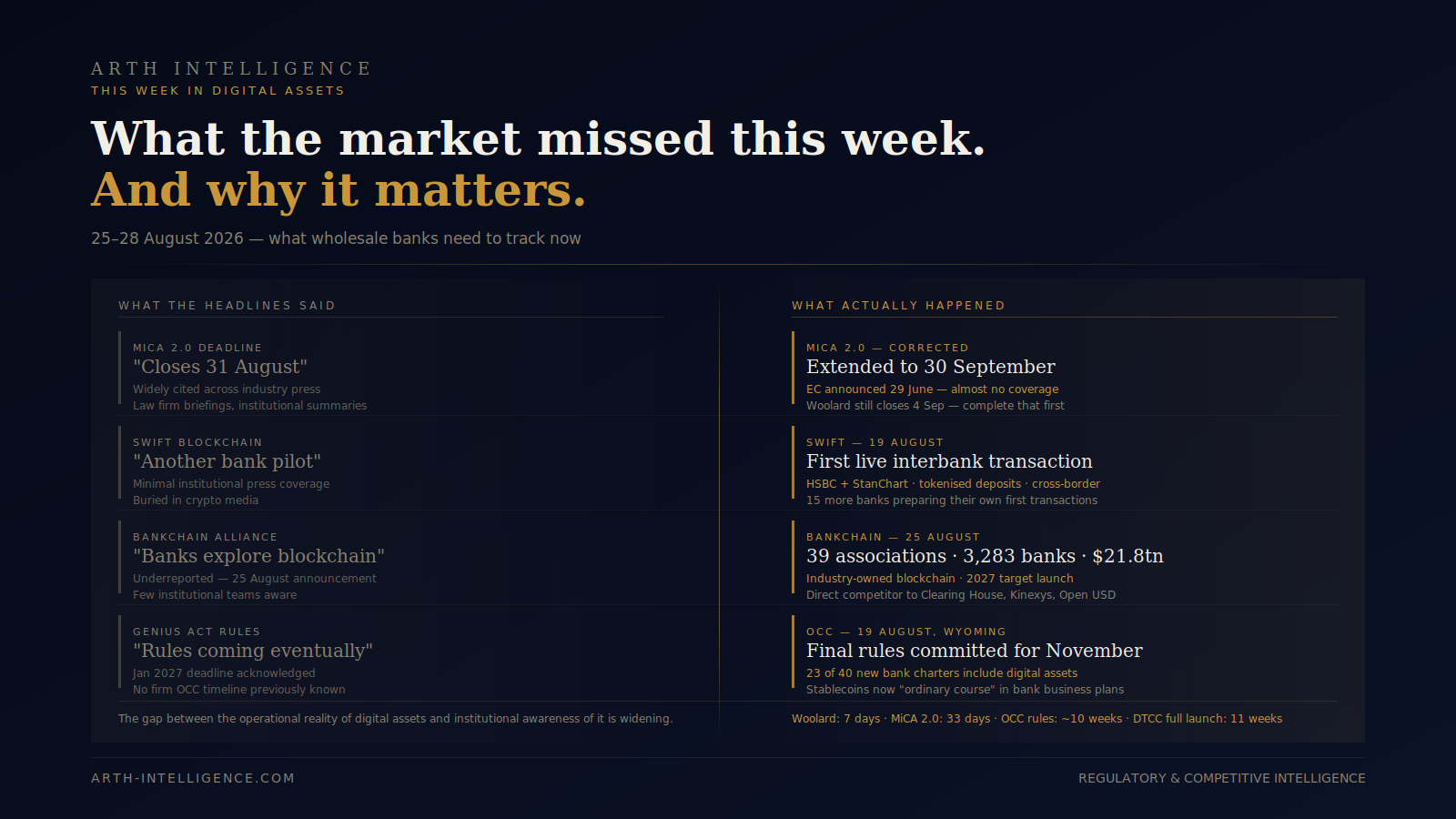
The most consequential developments in digital assets are frequently the ones that receive the least coverage. This week had four of them.
First: the MiCA 2.0 consultation deadline is not 31 August. It was extended to 30 September — the European Commission announced it on 29 June through its Finance News Hub, with no press release and almost no subsequent coverage. Law firm briefings kept citing 31 August. Regulatory trackers kept citing 31 August. The extension effectively disappeared from the institutional record. Your team has a month more than the market generally knows.
Second: on 19 August, HSBC and Standard Chartered executed the first live interbank transaction on Swift’s blockchain-based ledger — tokenised deposit obligations exchanged cross-border, matched and netted in real time. The first of 17 banks across six continents to go live. It received a fraction of the coverage it deserved.
Third: on 25 August, 39 US state banking associations formed the BankChain Alliance — 3,283 banks, $21.8 trillion in assets, targeting a 2027 launch of an industry-owned blockchain for tokenised deposits and stablecoins. Direct competitor to the Clearing House, Kinexys and Open USD. Most institutional teams will encounter it here for the first time.
Fourth: the OCC committed publicly on 19 August to final GENIUS Act rules by November. Not eventually. November. Ten weeks from now. With January 2027 fixed as the effective date, that window is not comfortable.
The gap between what is actually happening in digital assets and what the institutional market knows about it is the problem this series exists to address.
Woolard: 7 days. MiCA 2.0: 33 days. OCC final rules: ~10 weeks. DTCC full launch: 11 weeks.
This Week in Digital Assets: 17–21 August 2026
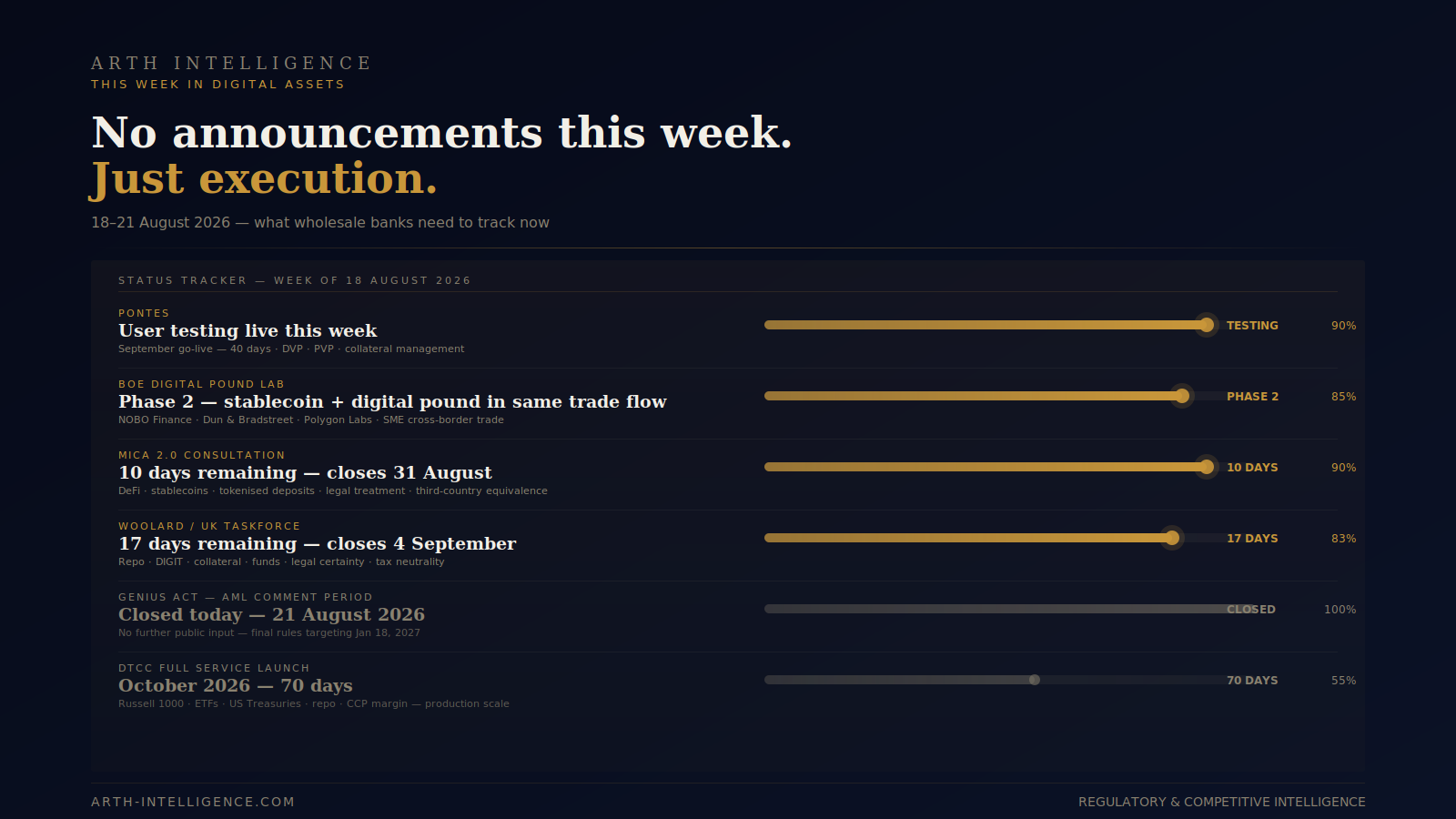
The Bank of England moved its Digital Pound Lab to Phase 2 on 12 August — and the architecture of what it’s testing matters. An exporter receives an advance via a stablecoin payment rail. A UK importer settles in a simulated digital pound. One transaction. Two forms of digital money. The same cross-border trade flow. Working with NOBO Finance, Dun & Bradstreet and Polygon Labs, the BoE is now generating empirical evidence for its own policy decision — on whether a digital pound gets built, and on the systemic/non-systemic split that will determine whether sterling stablecoins fall under BoE or FCA supervision. Those rules finalise by end of 2026. The compliance architecture needs to be designed before that.
Meanwhile, Pontes user testing began this week with market participants ahead of the September go-live. The ECB has quietly dropped the “pilot” label. This is production infrastructure. If your DLT platforms aren’t connected to it when it launches in 40 days, you’re settling in private money while connected institutions settle in central bank money.
MiCA 2.0 closes in 10 days. Woolard closes in 17. Both cover the same asset classes — tokenised deposits, DeFi perimeter, interoperability. Positions must be consistent across both. The GENIUS Act AML comment period closed today. No further public input. Final rules target January 18, 2027.
And Fidelity published this week what is arguably the most useful institutional tokenisation framework document of 2026 — with one finding that deserves board-level attention: the legal distinction between a token that evidences direct ownership of an underlying asset and one that provides synthetic exposure is not academic. It is the most important risk management question in your digital asset portfolio right now.
DTCC full service launch: 70 days. Digital Assets Week London: 46 days. Everything that matters in Q4 is being determined this week and next.
This Week in Digital Assets: 11–14 August 2026
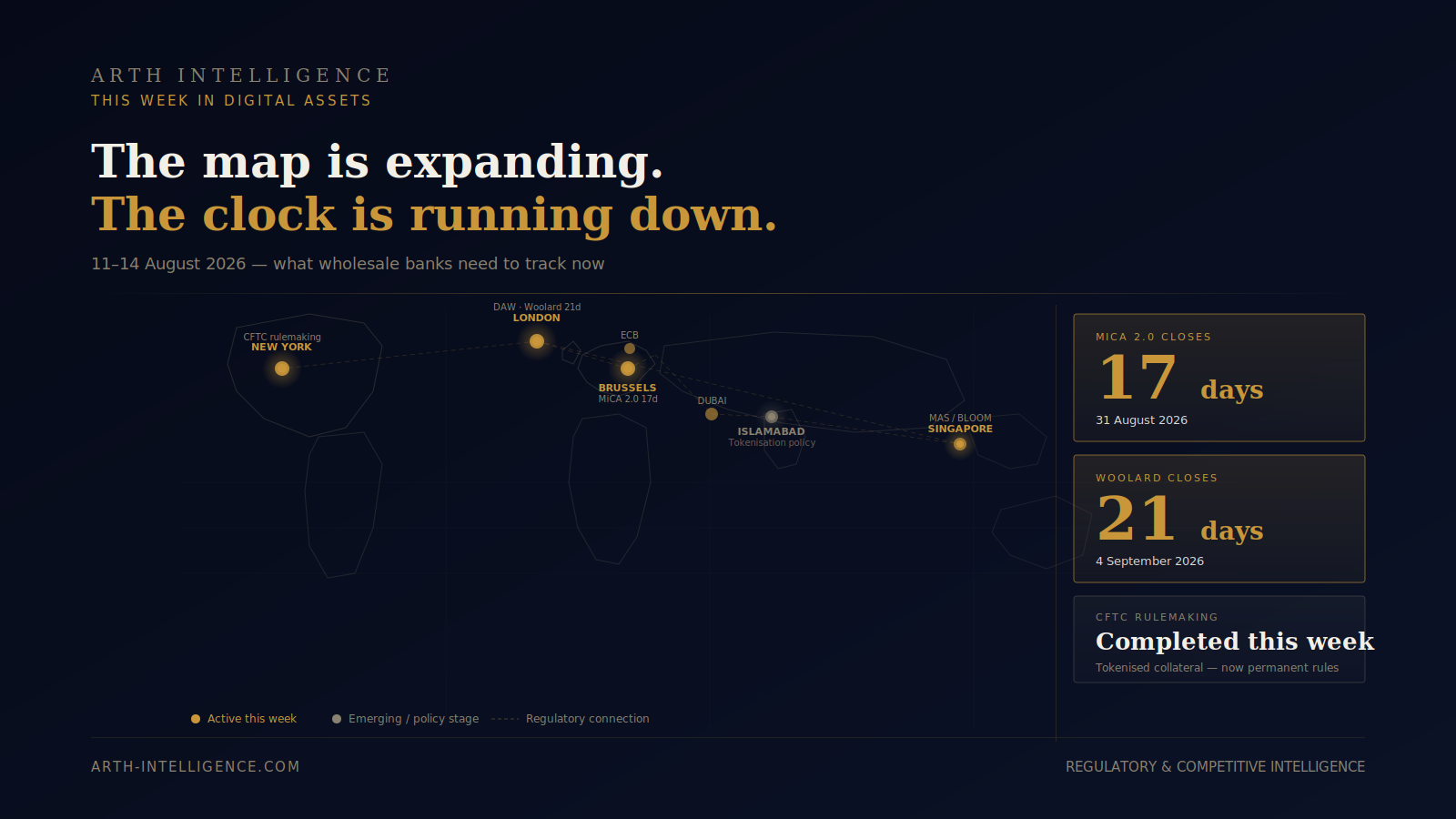
The map is expanding. The clock is running down.
This week the CFTC completed its August rulemaking deadline — tokenised collateral for derivatives is now embedded in permanent US rules, not just pilot guidance. Billions of dollars of tokenised Treasuries and MMF shares are now explicitly eligible as margin. If your collateral management desk hasn’t updated its eligible collateral framework, it’s operating on outdated assumptions.
Digital Assets Week London confirmed record institutional attendance for October — HM Treasury, Bank of England, US SEC, HSBC, Barclays, Fidelity, Citi all on one agenda. The first major institutional convening after DTCC’s full service launch, Pontes going live, and Woolard’s workplans being finalised.
And on Thursday, Pakistan announced it is exploring tokenisation of real estate and investment assets — joining a growing list of markets where the conversation has moved from academic to policy agenda.
Meanwhile: 17 days to MiCA 2.0. 21 days to Woolard. Both cover tokenised deposits, DeFi perimeter, interoperability. Positions must be consistent across both.
The window to shape what comes next closes in three weeks.

This Week in Digital Assets: 3–7 August 2026
Three deadlines. One five-day window. And the US just ran out of road.
On Thursday, the Senate confirmed it won’t vote on the CLARITY Act before the August recess. No cloture filed. Next window: September 15 at the earliest. Kalshi’s prediction markets dropped eight percentage points — CLARITY passing before July 2027 now sits at 41%. The foundational US digital asset market structure legislation has effectively missed 2026.
Meanwhile in Europe, two consultation deadlines are converging on the same five-day window. MiCA 2.0 closes 31 August — covering DeFi, stablecoins, tokenised deposits, and the legal treatment of tokens. The Woolard consultation closes 4 September — covering repo, DIGIT, collateral, fund tokenisation, and interoperability standards. Both cover the same asset classes. Both will shape the frameworks your institution operates under for the next five years. And the positions you take in one need to be consistent with the positions you take in the other.
24 days to MiCA 2.0. 28 days to Woolard. 54 days to Pontes.
The institutions that engage with all three will shape the frameworks. The ones that don’t will inherit them.
This Week in Digital Assets: 27-31 July 2026
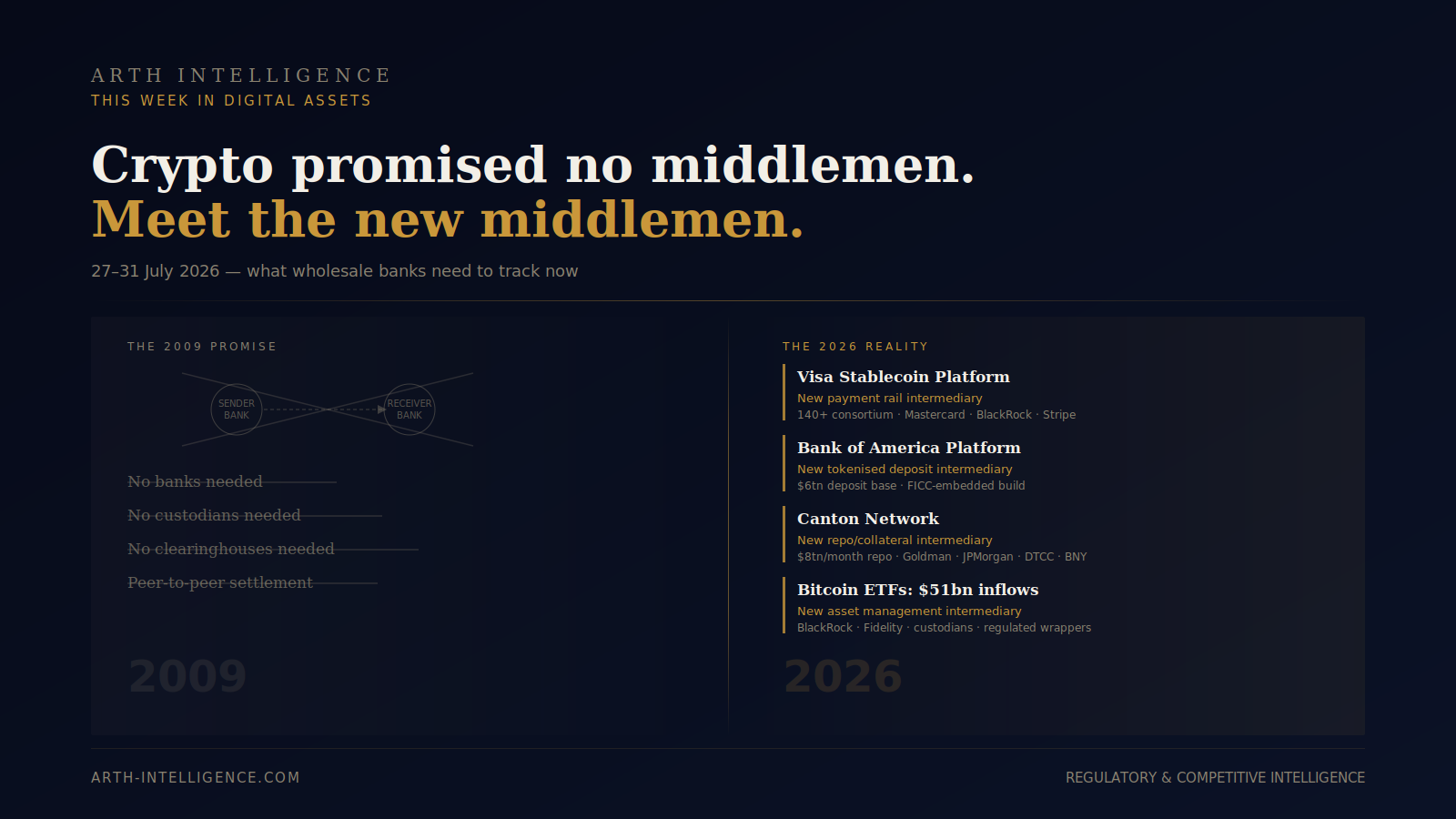
Crypto began with a promise: remove the middlemen. No banks. No custodians. No clearinghouses. Just code and peer-to-peer settlement.
Fifteen years later, the data tells a different story. Bitcoin ETFs have attracted $51 billion in inflows — through BlackRock and Fidelity. Canton Network processes $8 trillion in monthly repo — with Goldman, JPMorgan, DTCC and BNY at the centre. Visa launched a stablecoin platform backed by 140+ institutions. Bank of America built its digital assets platform inside FICC electronic trading. And Brian Moynihan warned that $6 trillion in deposits could migrate to stablecoins — which is exactly why BofA is building the infrastructure to capture that migration rather than lose it.
The intermediaries didn’t disappear. They got new names, new rails, and new network effects. The institutions understanding this now are making better capital allocation decisions than those still reading the disintermediation narrative.
This Week in Digital Assets: 20–24 July 2026
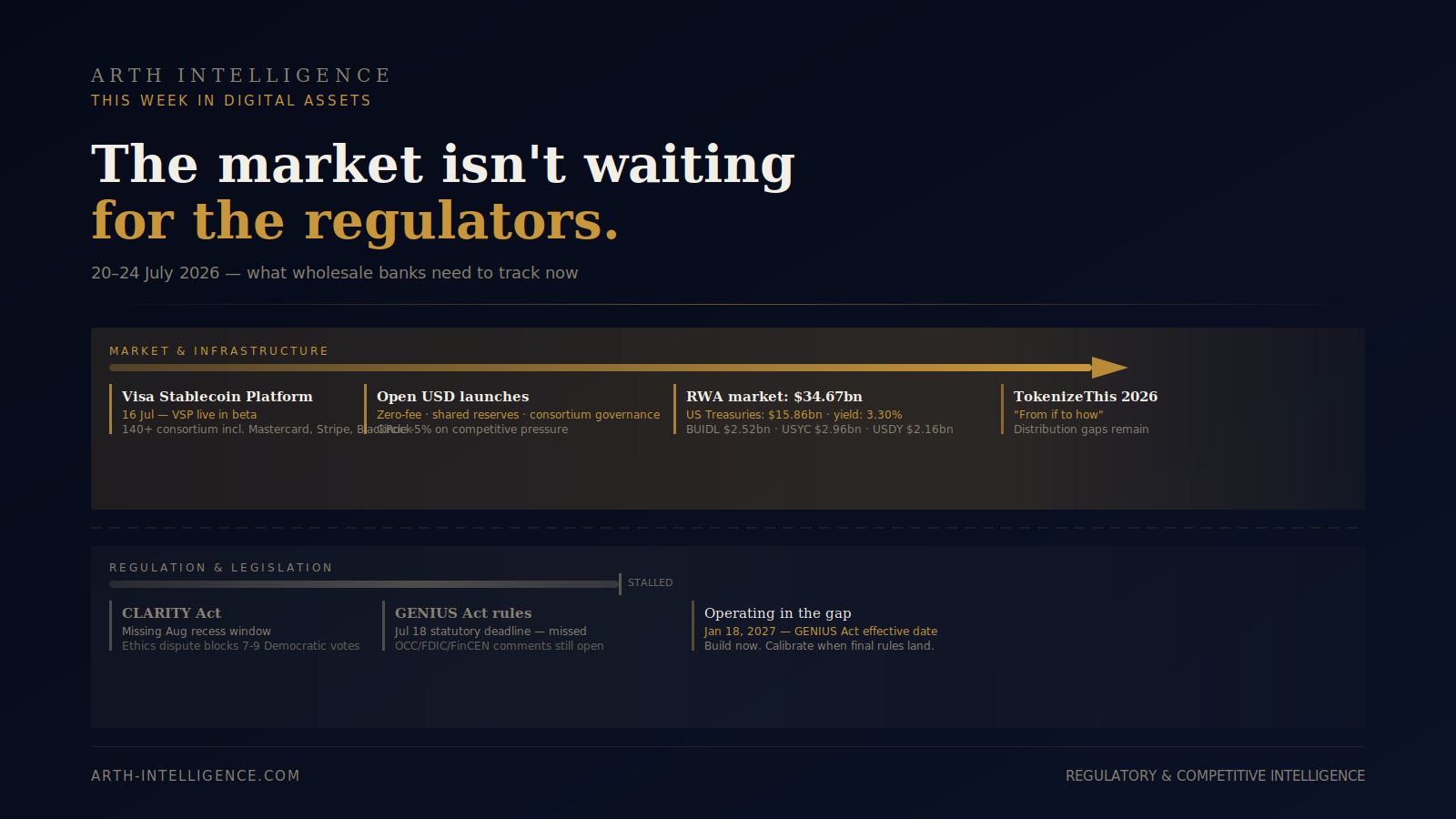
On Thursday, Visa launched the Visa Stablecoin Platform — allowing banks, fintechs and crypto firms to mint, move and redeem stablecoins through a single Visa-managed environment, backed by a 140+ member consortium including Mastercard, Stripe, Coinbase and BlackRock. Infrastructure live, rules still being written.
Meanwhile, the CLARITY Act — the 616-page US crypto market structure bill — is expected to miss its August recess window after Senate Majority Leader Thune signalled floor time will go to a Russia sanctions bill first. The July 18 GENIUS Act rulemaking deadline also passed without final rules in place. OCC, FDIC and FinCEN comment periods remain open through August 21.
The tokenised RWA market hit $34.67 billion as of July 22. US Treasuries alone account for $15.86 billion. The institutions capturing that value — BlackRock, Circle, Ondo, Franklin Templeton — aren’t waiting for a clean regulatory runway.
The question for wholesale banks isn’t whether to wait for regulatory clarity. It’s whether you’re navigating the gap intelligently, or just waiting.
This Week in Digital Assets: 13-17 July 2026
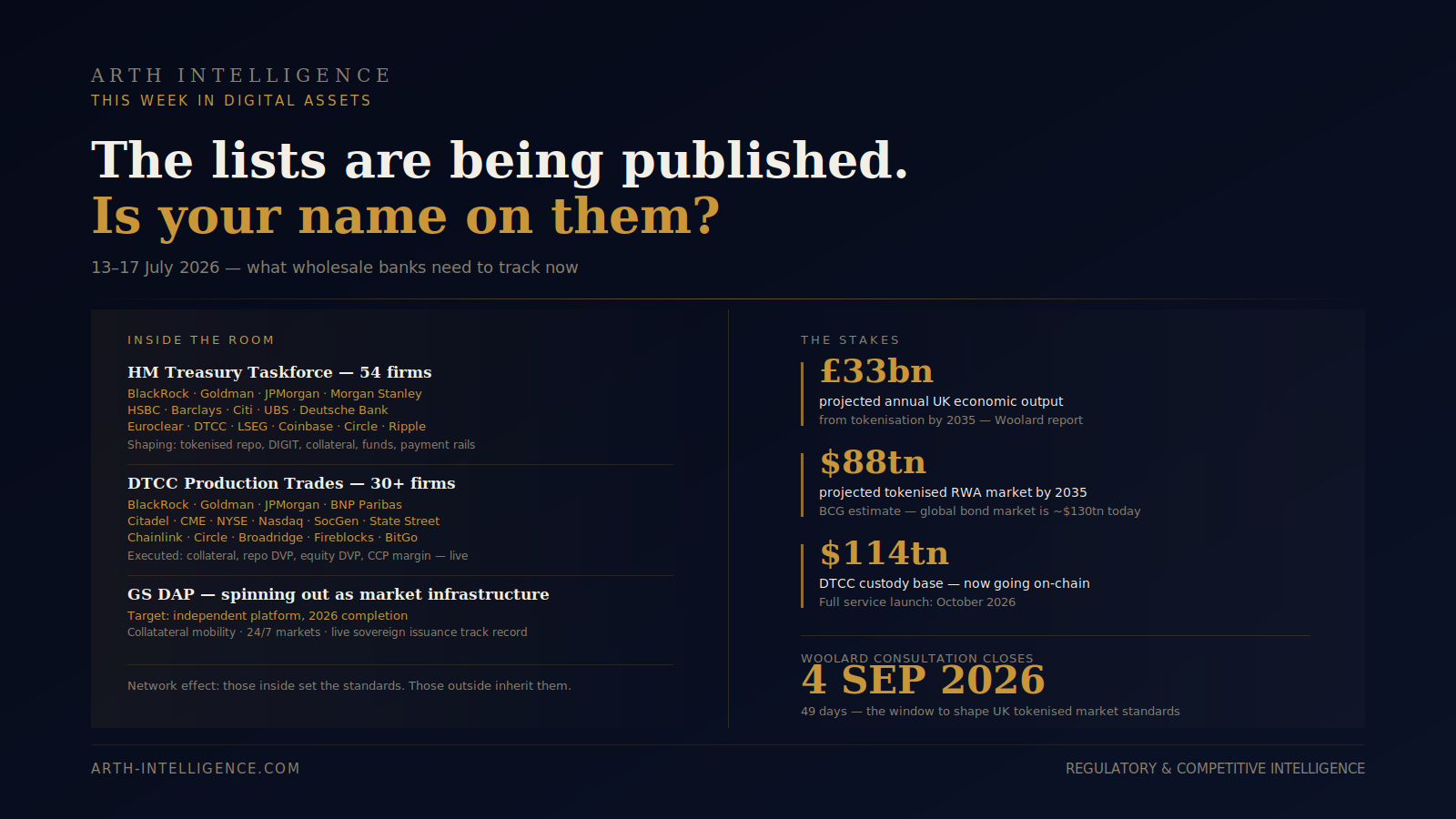
On Monday, HM Treasury launched a 54-firm tokenisation taskforce — BlackRock, Goldman, JPMorgan, HSBC, Barclays, Citi, Euroclear, LSEG, Coinbase, Circle and 44 others — with a mandate to build live tokenised repo, digital gilt issuance and collateral infrastructure within 12 months. On Tuesday, DTCC processed the first live production trades of tokenised securities in history — equities, ETFs, Treasuries, repo, collateral and CCP margin — with 30+ named firms including Goldman, JPMorgan, BNP Paribas, SocGen, NYSE, Nasdaq and Chainlink executing real trades in a production environment. And Goldman Sachs confirmed it is spinning out GS DAP as an independent market infrastructure platform.
The institutions on these lists are building the interoperability standards, the legal frameworks, the collateral eligibility rules and the repo architecture that will govern tokenised wholesale markets for the next decade.
The Woolard consultation closes 4 September. That’s 49 days to influence the framework — or inherit it.
This Week in Digital Assets: 7–10 July 2026
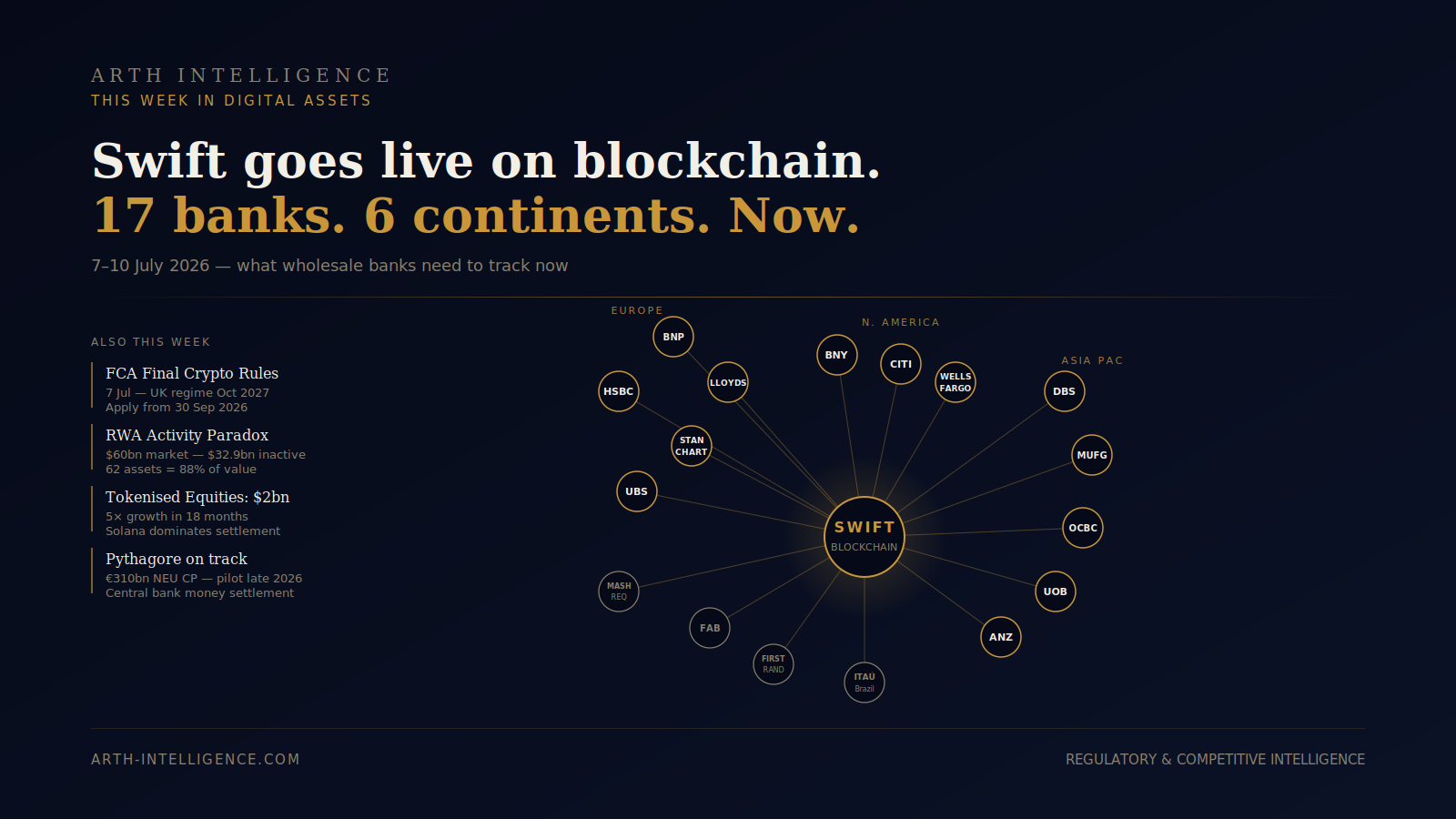
On Thursday, Swift announced its blockchain-based ledger is ready for initial use.
17 banks. 6 continents. BNP Paribas, HSBC, Lloyds, Standard Chartered, UBS, BNY, Citi, Wells Fargo, DBS, MUFG, and seven more — all preparing to pilot live tokenised deposit transactions for 24/7 cross-border payments.
This isn’t a pilot on new infrastructure. It’s an upgrade to the rails that already carry global GDP every two to three days. Funds move instantly overnight and on weekends. Final settlement still happens through RTGS when markets open. The 24/7 gap — the one stablecoins have been filling — just got a bank-grade answer.
That was the headline. But this week also gave us the most important uncomfortable truth in digital assets right now: of 1,289 tokenised assets above $100k in value, 910 of them — $32.9 billion — showed zero weekly activity. The $60bn market headline is real. The liquid, accessible, institutionally-ready market is far smaller and far more concentrated.
This Week in Digital Assets: 29 June – 3 July 2026
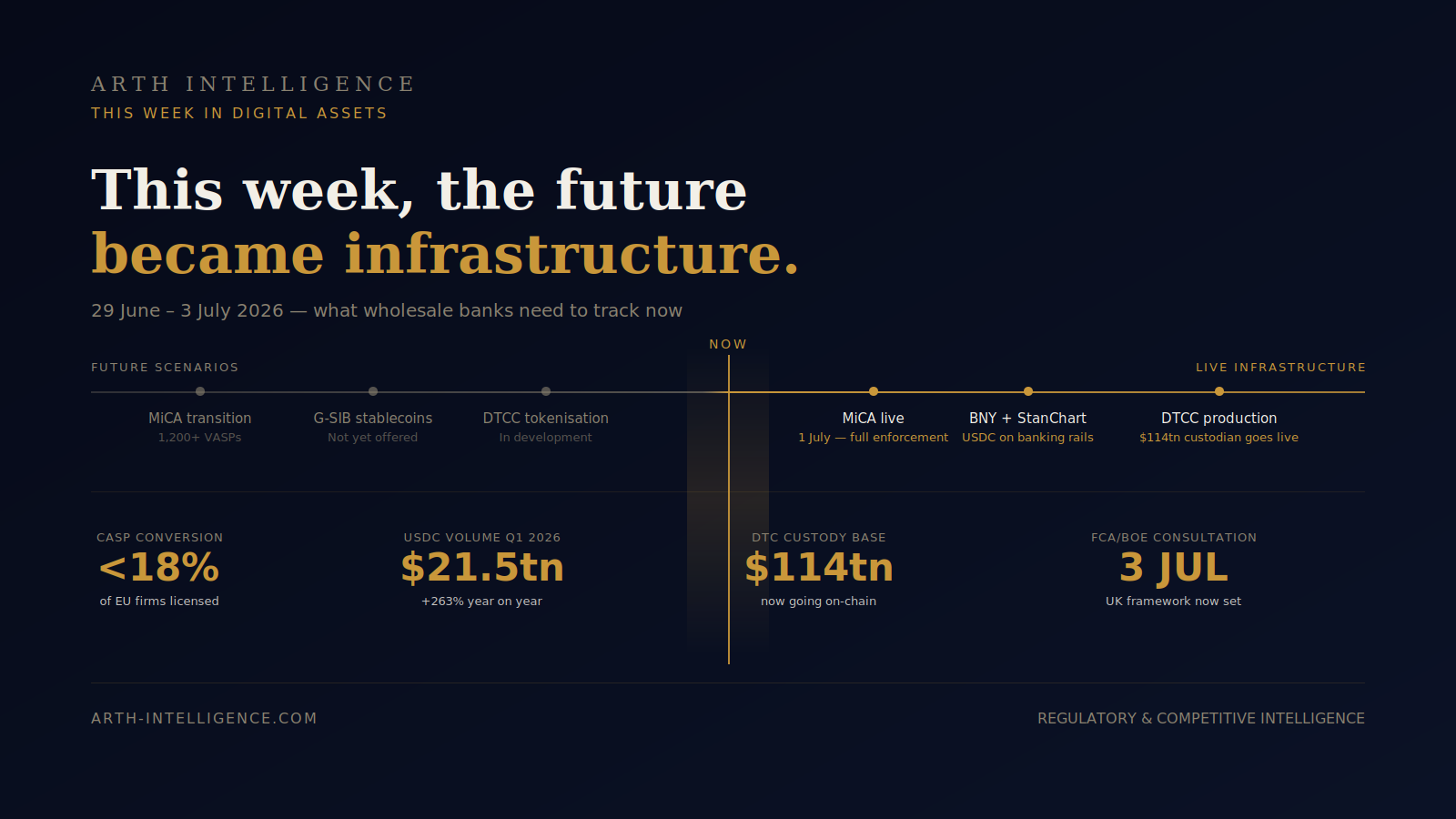
On 29 June, BNY — custodian of $59 trillion — made USDC the first stablecoin on its Digital Asset Custody platform. On 2 July, Standard Chartered became the first G-SIB to offer institutional USDC minting and redemption through a single banking relationship. And this week, DTCC began real production trades of tokenised securities — pulling $114 trillion in custodied assets toward on-chain infrastructure for the first time.
The FCA/BoE tokenisation consultation also closed on 3 July. The UK framework is now being built from the responses received. If you didn’t submit, you’ll inherit what others designed.
Five developments. One direction. The question now isn’t whether to engage — it’s how far behind you are.
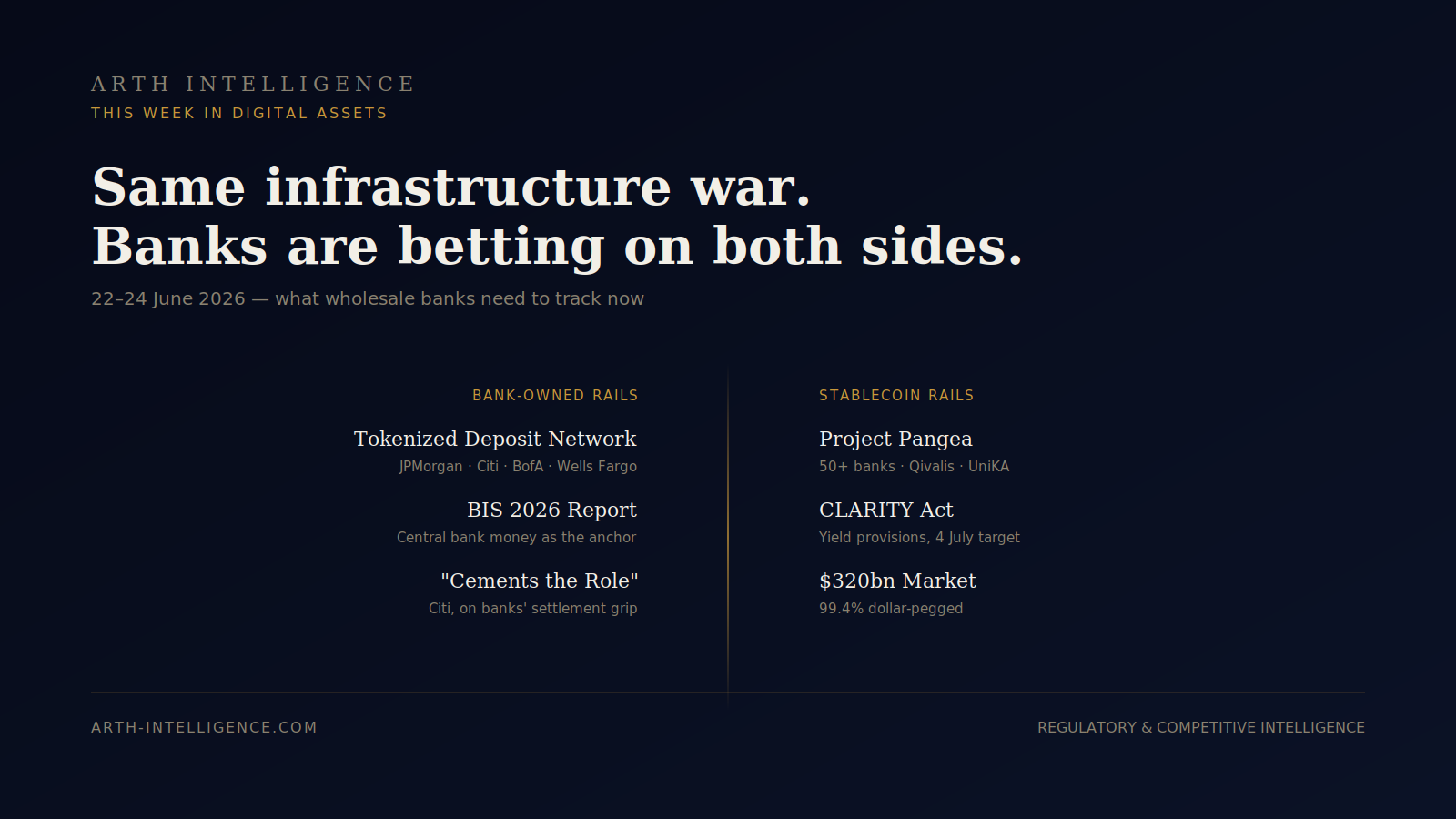
This Week in Digital Assets: 22–24 June 2026
Same infrastructure war. Banks are betting on both sides.
This week, 50+ banks — including Qivalis’s European consortium — launched Project Pangea to test stablecoins for institutional FX settlement. Days earlier, JPMorgan, Citi, BofA and Wells Fargo sharpened their case for bank-owned tokenised rails, explicitly designed to keep stablecoins out of the institutional payment stack. The BIS used its 2026 Annual Economic Report to back the bank-owned model. Meanwhile, the CLARITY Act races toward a 4 July deadline that could make dollar stablecoins more competitive than ever.
Nobody knows which side wins yet. That’s exactly why the banks paying closest attention to both are the ones building real advantage.
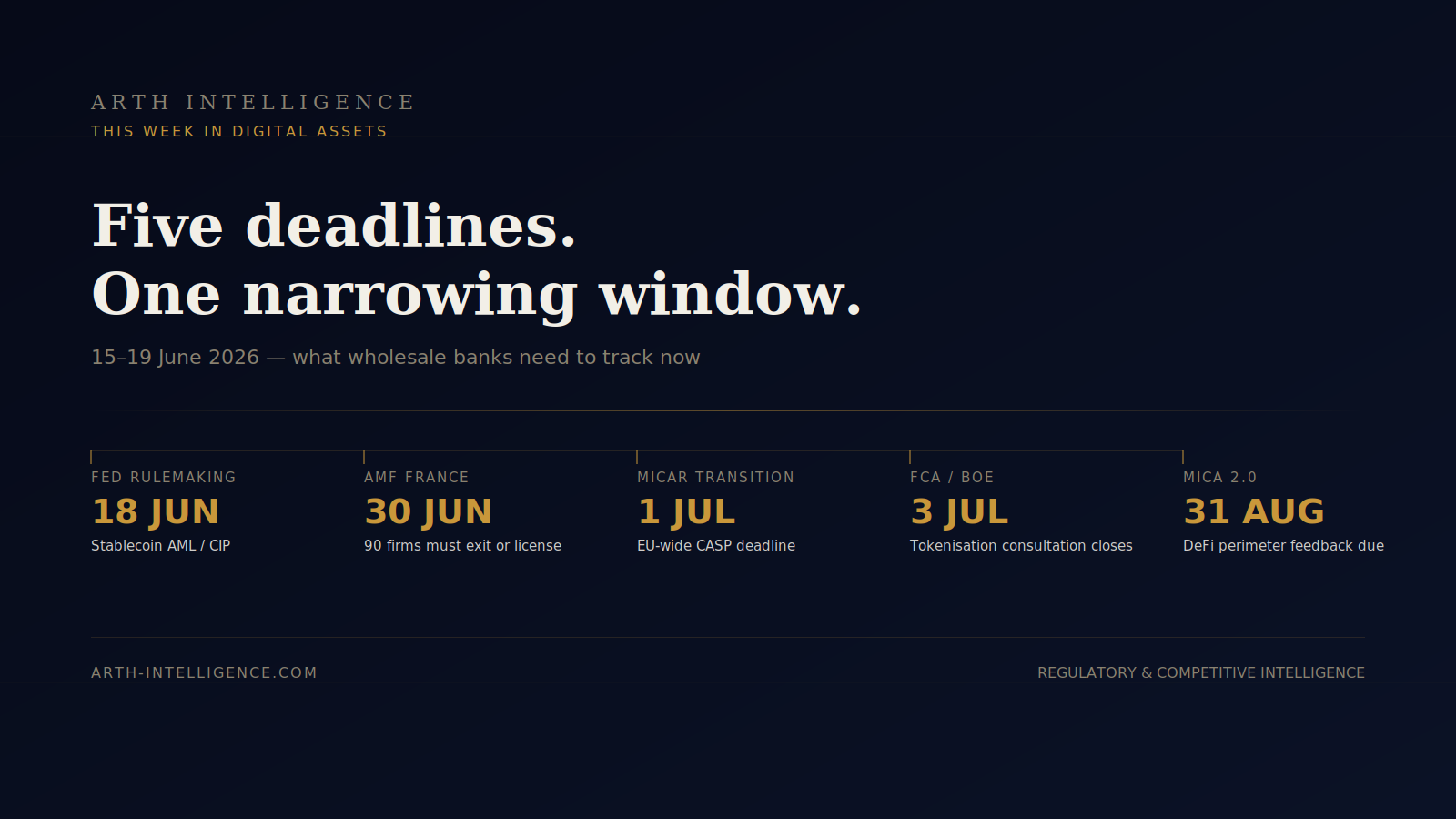
This Week in Digital Assets: 15–19 June 2026
Five deadlines. One narrowing window.
This week wasn’t about flashy product launches, it was about the regulatory clock tightening from every direction. The Fed dropped 130 pages of stablecoin AML rules. France gave 90 unlicensed crypto firms 11 days to license or exit. The UK’s tokenisation consultation closes in two weeks. MiCA 2.0 keeps gathering momentum toward August.
None of these made front-page headlines. All of them will shape who gets to operate, and on whose terms, for years.
The institutions paying attention to dates like these, not just the big announcements, are the ones building real competitive advantage right now.
MiCAR at the Cliff Edge: What the July Deadline Actually Means for Wholesale Banks
MiCAR is landmark regulation. It’s also answering the wrong questions for wholesale banks.
After 1 July, any CASP without authorisation must cease EU operations. Only ~17% of pre-MiCA registered providers have converted. The counterparty exposure risk alone should be keeping treasury and compliance teams busy right now.
But here’s the real issue: tokenised bonds, funds, and equities — the assets at the heart of every institutional tokenisation strategy — sit entirely outside MiCAR. They live in MiFID II and the DLT Pilot Regime. And MiCA 2.0, launched 20 May with a feedback deadline of 31 August, is about to start closing those gaps.
The patchwork of frameworks — MiCAR, MiFID II, EMIR, Pontes interoperability standards — is where the real compliance and strategic risk lives. Not in the regulation everyone’s already read.

90 days to Pontes. Is your Bank ready?
Pontes goes live in Q3 2026. That’s 90 days away.
Every major institution is building tokenised infrastructure. JPMorgan on Ethereum. Goldman spinning out GS DAP. Twelve European banks racing to launch a euro stablecoin before the ECB’s own settlement layer beats them to it.
But here’s what most banks aren’t asking: when Pontes connects DLT platforms to central bank money for the first time — are your rails compatible, or are you suddenly settling in private money while your counterparties aren’t?
The urgency isn’t 2029. It’s this quarter.

Three Banks. Three Strategies. One Race Mid-Tier Banks Are Losing
JPMorgan, Citi and SG-FORGE have each spent years building digital assets infrastructure. They’re not doing the same thing.
Kinexys is a volume play — own the rails, run the flows, process $5 billion a day until network effects make you indispensable. Citi Token Services is a client orchestration play — embed digital rails into existing treasury workflows without asking clients to move. SG-FORGE is an infrastructure-as-product play — build the end-to-end issuance and settlement capability and offer it to the market as a service.
Three different structural bets. Three different implications for mid-tier banks.
The question isn’t which model to copy. It’s what each one means for your counterparty relationships, your client ownership, and your window to act before the Pontes moment reshapes the competitive map entirely.

The Cost of Inaction: Why “Wait and See” Is Already a Decision
“We’re monitoring the space.”
It sounds like risk management. It isn’t. It’s a decision — and like every decision in banking, it has a cost.
In wholesale banking, the cost of inaction in digital assets falls into three dimensions: revenue at risk as flows migrate to faster rails, counterparty dependency as Tier-1 infrastructure pulls mid-tier banks into an orchestrated position, and governance rights forfeited in regulatory consultations that close this summer and won’t reopen.
Every quarter of delay has a price. The question is whether your institution knows what that price is — and whether you’re choosing to pay it deliberately, or by default.
I’ve built a framework for making that cost concrete — mapped to your revenue lines, your infrastructure exposure, and the regulatory windows closing right now.