

See what matters
This week in Digital Assets
Blog
The most consequential developments in digital assets are frequently the ones that receive the least coverage. This week had four of them.
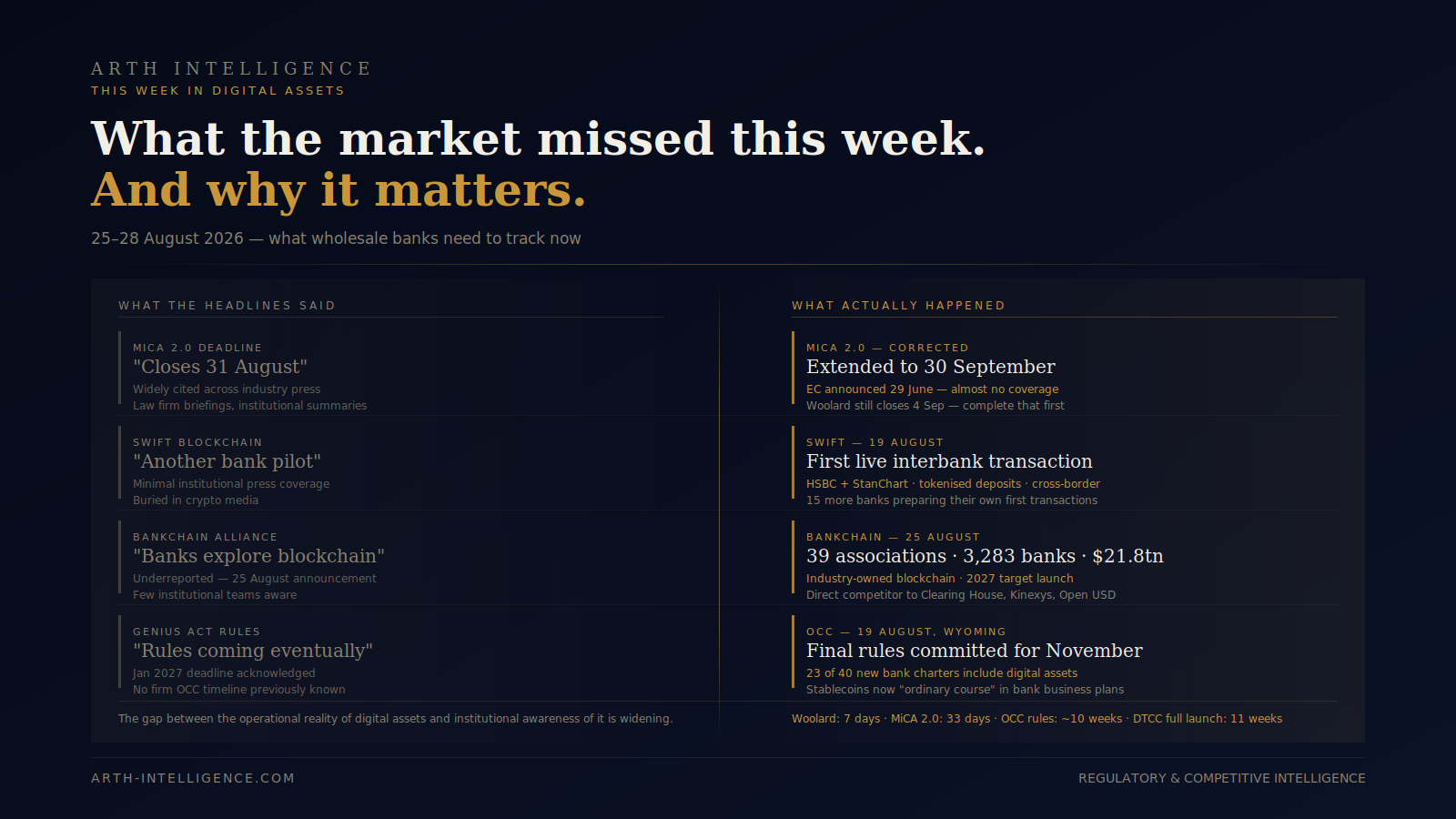
First: the MiCA 2.0 consultation deadline is not 31 August. It was extended to 30 September — the European Commission announced it on 29 June through its Finance News Hub, with no press release and almost no subsequent coverage. Law firm briefings kept citing 31 August. Regulatory trackers kept citing 31 August. The extension effectively disappeared from the institutional record. Your team has a month more than the market generally knows.
Second: on 19 August, HSBC and Standard Chartered executed the first live interbank transaction on Swift’s blockchain-based ledger — tokenised deposit obligations exchanged cross-border, matched and netted in real time. The first of 17 banks across six continents to go live. It received a fraction of the coverage it deserved.
Third: on 25 August, 39 US state banking associations formed the BankChain Alliance — 3,283 banks, $21.8 trillion in assets, targeting a 2027 launch of an industry-owned blockchain for tokenised deposits and stablecoins. Direct competitor to the Clearing House, Kinexys and Open USD. Most institutional teams will encounter it here for the first time.
Fourth: the OCC committed publicly on 19 August to final GENIUS Act rules by November. Not eventually. November. Ten weeks from now. With January 2027 fixed as the effective date, that window is not comfortable.
The gap between what is actually happening in digital assets and what the institutional market knows about it is the problem this series exists to address.
Woolard: 7 days. MiCA 2.0: 33 days. OCC final rules: ~10 weeks. DTCC full launch: 11 weeks.
The Bank of England moved its Digital Pound Lab to Phase 2 on 12 August — and the architecture of what it’s testing matters. An exporter receives an advance via a stablecoin payment rail. A UK importer settles in a simulated digital pound. One transaction. Two forms of digital money. The same cross-border trade flow. Working with NOBO Finance, Dun & Bradstreet and Polygon Labs, the BoE is now generating empirical evidence for its own policy decision — on whether a digital pound gets built, and on the systemic/non-systemic split that will determine whether sterling stablecoins fall under BoE or FCA supervision. Those rules finalise by end of 2026. The compliance architecture needs to be designed before that.
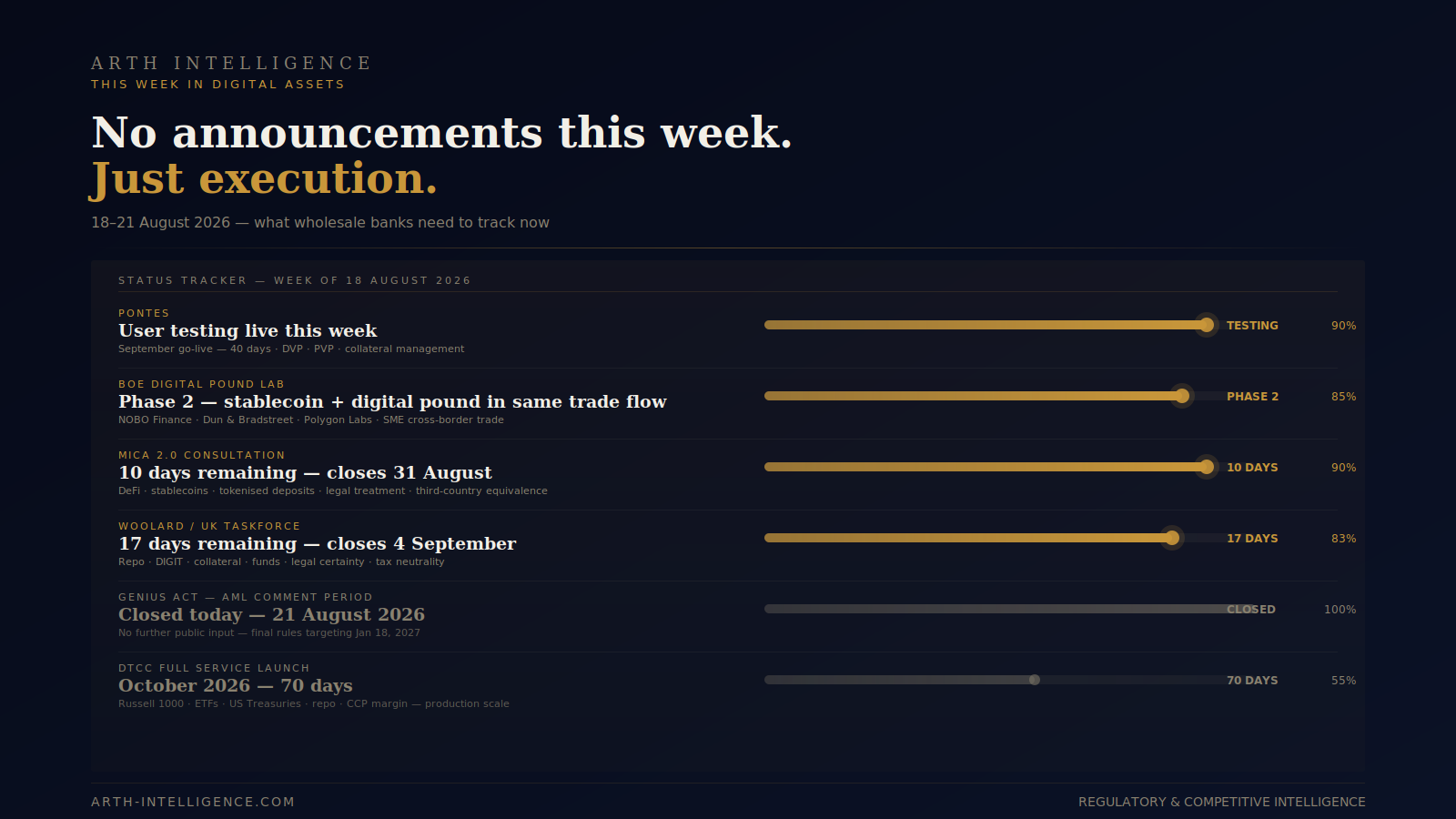
Meanwhile, Pontes user testing began this week with market participants ahead of the September go-live. The ECB has quietly dropped the “pilot” label. This is production infrastructure. If your DLT platforms aren’t connected to it when it launches in 40 days, you’re settling in private money while connected institutions settle in central bank money.
MiCA 2.0 closes in 10 days. Woolard closes in 17. Both cover the same asset classes — tokenised deposits, DeFi perimeter, interoperability. Positions must be consistent across both. The GENIUS Act AML comment period closed today. No further public input. Final rules target January 18, 2027.
And Fidelity published this week what is arguably the most useful institutional tokenisation framework document of 2026 — with one finding that deserves board-level attention: the legal distinction between a token that evidences direct ownership of an underlying asset and one that provides synthetic exposure is not academic. It is the most important risk management question in your digital asset portfolio right now.
DTCC full service launch: 70 days. Digital Assets Week London: 46 days. Everything that matters in Q4 is being determined this week and next.
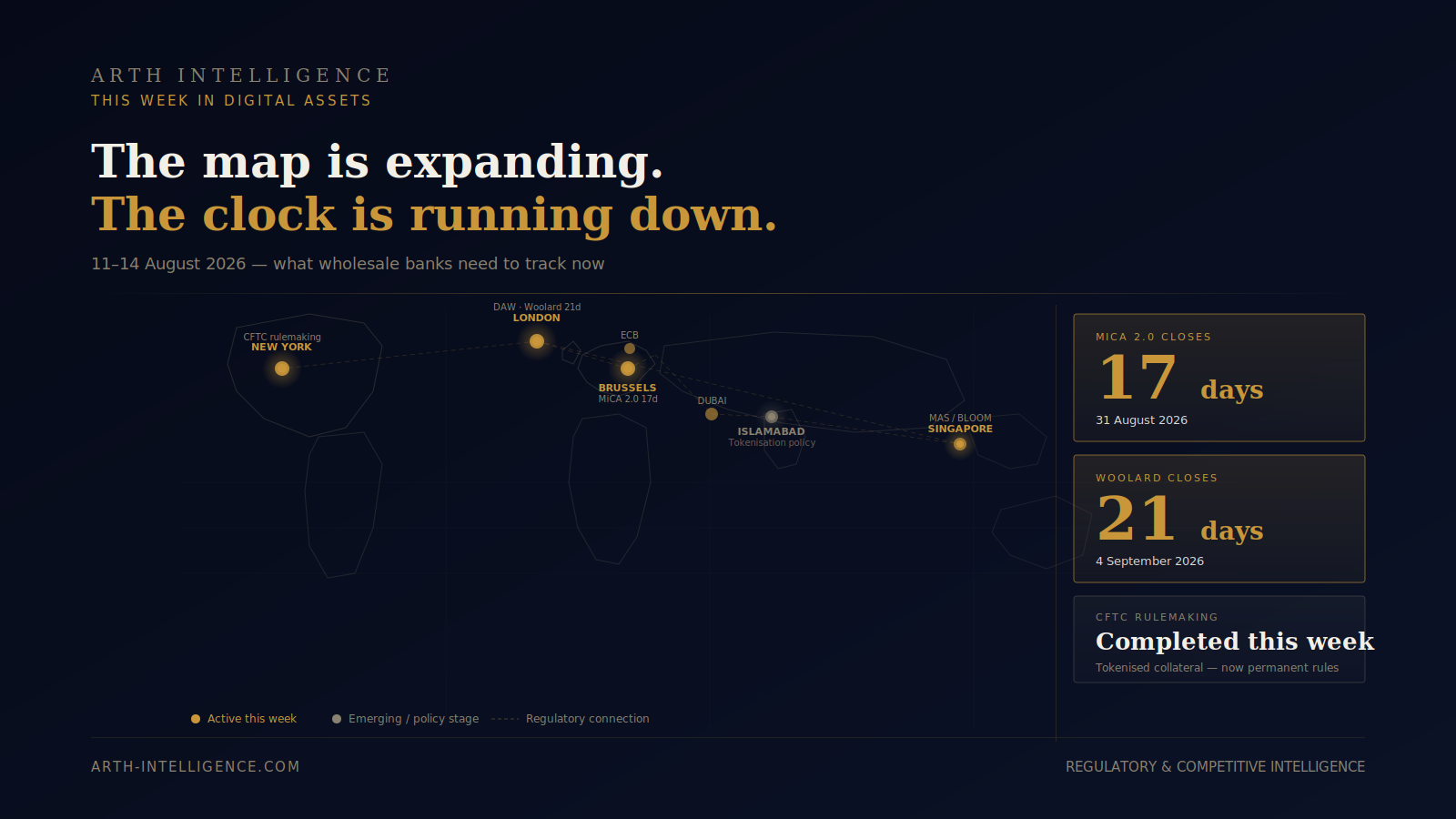
The map is expanding. The clock is running down.
This week the CFTC completed its August rulemaking deadline — tokenised collateral for derivatives is now embedded in permanent US rules, not just pilot guidance. Billions of dollars of tokenised Treasuries and MMF shares are now explicitly eligible as margin. If your collateral management desk hasn’t updated its eligible collateral framework, it’s operating on outdated assumptions.
Digital Assets Week London confirmed record institutional attendance for October — HM Treasury, Bank of England, US SEC, HSBC, Barclays, Fidelity, Citi all on one agenda. The first major institutional convening after DTCC’s full service launch, Pontes going live, and Woolard’s workplans being finalised.
And on Thursday, Pakistan announced it is exploring tokenisation of real estate and investment assets — joining a growing list of markets where the conversation has moved from academic to policy agenda.
Meanwhile: 17 days to MiCA 2.0. 21 days to Woolard. Both cover tokenised deposits, DeFi perimeter, interoperability. Positions must be consistent across both.
The window to shape what comes next closes in three weeks.